


Artificial intelligence is rapidly evolving from experimentation to operational deployment. Many organizations have already launched pilots, integrated generative AI assistants into workflows, or embedded machine learning into critical business processes.
But as adoption accelerates, a new question emerges: how do you measure the real impact of AI?
Across industries, companies report impressive return on investment figures. Yet when leaders look deeper, it is often difficult to clearly explain where that value originates. Without a structured approach to measuring AI impact, initiatives risk being perceived as promising experiments rather than measurable business drivers.
Understanding how to evaluate AI performance, quantify ROI, and connect AI initiatives to business outcomes has therefore become essential for organizations scaling enterprise AI.
Why measuring AI value is challenging
Unlike traditional IT investments, artificial intelligence generates value in complex and sometimes indirect ways. The impact of AI often emerges gradually as systems improve and adoption increases across the organization.
Three structural factors make measuring AI impact particularly challenging.
First, AI value develops over time. Models continuously learn from data and improve their predictions, meaning the full benefits of AI often appear months after deployment.
Second, attribution can be difficult. AI systems rarely operate in isolation. They are typically integrated into broader workflows, making it hard to determine exactly how much of an improvement comes from the AI itself.
Third, many benefits are intangible. Improvements in decision quality, customer satisfaction or employee productivity create real business value but are not always immediately visible in financial metrics.
Because of these challenges, organizations need a clear and structured framework to measure AI impact effectively.

Measuring AI impact – A practical framework for business leaders
Download ebookBuilding a structured framework to evaluate AI impact
A reliable approach to evaluating AI impact begins with understanding the full investment required to deploy and operate AI solutions. This means considering not only development costs but also infrastructure, data preparation, system integration, training, and ongoing maintenance.
This broader view is known as Total Cost of Ownership (TCO). By assessing the complete lifecycle cost of an AI initiative, organizations gain a more accurate picture of its financial implications.
Equally important is defining success before implementation. Establishing clear performance indicators and business KPIs ensures that every AI initiative is aligned with measurable objectives.
AI value can then be evaluated across several dimensions:
- Direct financial impact, such as increased revenue or reduced operational costs
- Operational efficiency gains, including faster processes, automation, and improved productivity
- Strategic and intangible benefits, such as better decision-making, improved customer experience, or increased innovation capacity
When these dimensions are combined, organizations can develop a comprehensive view of AI business value.
A structured framework for AI impact measurement
Measuring AI impact requires linking success metrics, investment, and outcomes within a single framework.
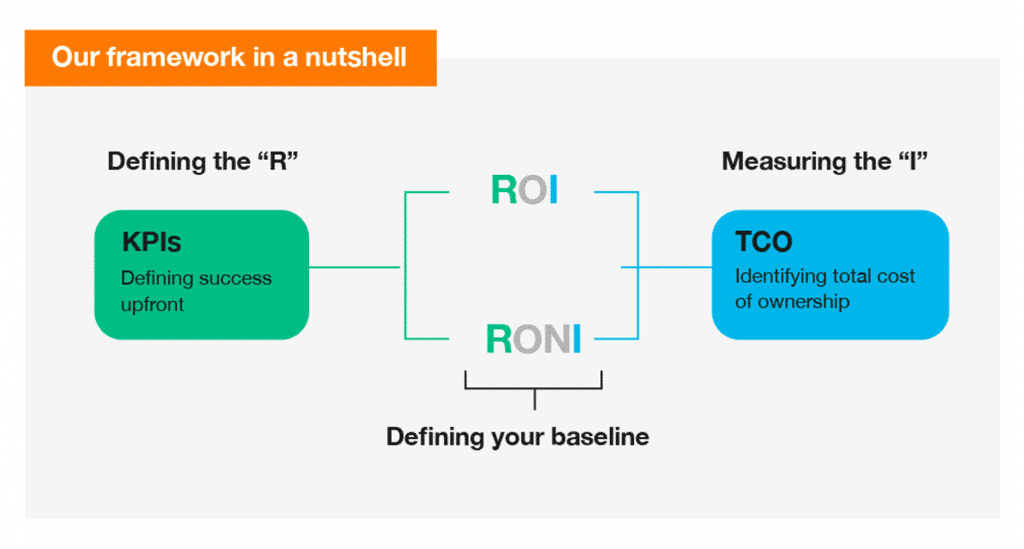
Organizations must begin by defining success indicators and establishing measurable KPIs. At the same time, they must identify the full Total Cost of Ownership, which captures both the initial investment and the long-term operational costs of AI systems.
A reliable baseline is also essential. By documenting performance before deployment, companies can compare results after implementation and determine whether AI is truly driving improvements.
Once these elements are in place, leaders can calculate return on investment (ROI) and assess risk of non-investment (RONI). Together, these metrics help organizations translate AI initiatives into measurable and defensible business value.
Understanding the AI impact pyramid
Not all AI initiatives generate value in the same way. The potential impact of AI evolves as systems become more deeply integrated into business operations.
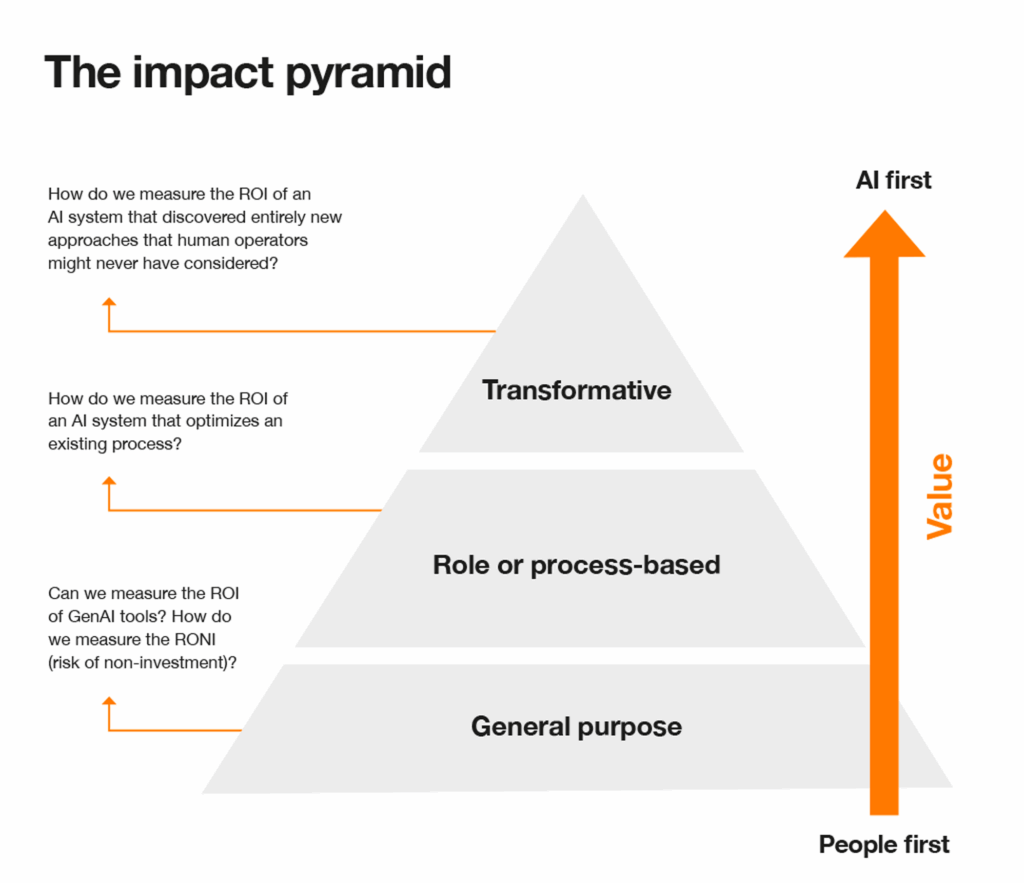
At the base of the pyramid are general-purpose AI tools, such as generative AI assistants and productivity copilots. These technologies primarily improve individual productivity and support everyday knowledge work.
The next level includes role-specific or process-based AI applications. Here, AI is embedded within operational workflows, helping teams optimize processes, automate tasks, and improve efficiency.
At the top are transformative AI systems. These solutions reshape business operations, introduce new capabilities, or create entirely new ways of delivering products and services. While they offer the greatest potential value, they also require more sophisticated approaches to measuring their impact.
Understanding where an AI initiative sits within this pyramid helps organizations set realistic expectations and apply the right measurement methods.
ROI, RONI, and strategic AI investment
Return on investment remains one of the most important indicators for evaluating AI initiatives. However, focusing solely on ROI can overlook the broader strategic value of AI.
Some AI deployments generate immediate financial returns, while others build capabilities that will shape future competitiveness. In these cases, organizations must also consider risk of non-investment (RONI).
RONI evaluates the potential consequences of delaying AI adoption, such as reduced productivity, slower innovation cycles, or losing competitive advantage. Combining ROI analysis with RONI provides a more complete picture of the strategic importance of AI.
From AI experiments to evidence-based strategy
As artificial intelligence becomes central to digital transformation strategies, organizations must move beyond experimentation toward measurable outcomes.
Companies that develop strong capabilities in AI impact measurement will be better equipped to prioritize investments, demonstrate value to stakeholders, and scale successful initiatives across the organization.
Ultimately, the organizations that succeed with AI will not simply deploy new technologies. They will systematically measure their impact, refine their strategies, and transform AI initiatives into sustainable sources of business value.











Comments (0)
Your email address is only used by Business & Decision, the controller, to process your request and to send any Business & Decision communication related to your request only. Learn more about managing your data and your rights.