


Adobe Campaign Classic v7 customers will need to reassess their strategic choices.
Indeed, Adobe Campaign Classic v7 will no longer be supported after March 31, 2027. This deadline defines a clear timeframe to prepare a structured decision — whether that involves an upgrade, a replacement, or a broader transformation of the marketing stack.
What options are available? Which path makes the most sense depending on your context?
This article takes a closer look.
Adobe Campaign v7: four options to consider
At first glance, the simplest option might seem to be moving to Adobe Campaign v8. However, there is a real technological break between the two versions. More than a straightforward upgrade, this is effectively a migration — one that requires a significant effort, both in terms of resources and budget.
This observation therefore calls for a more thorough review of the situation and of the options available.
In this article, aimed at CRM leaders and CIOs, four realistic scenarios are outlined in a neutral way to help organizations make an informed decision based on their specific context:
- Remaining on Adobe Campaign Classic v7
- Migrating to Adobe Campaign v8
- Switching to a different marketing automation platform
- Rethinking the overall approach
After many years using the same tool, it is both natural and valuable to reassess current market standards, explore the range of available options, and revisit best practices to ensure informed decision-making.

The simplest short-term option: remaining on Adobe Campaign Classic v7
The first option, which allows organizations to postpone a resource-intensive migration project in the short term, is simply to extend the use of the existing Adobe Campaign Classic v7 platform until at least the end of standard support and, if required, to subscribe to Extended Support services.
This approach makes it possible to “buy time” to build a more comprehensive migration plan, including project phases, vendor selection, proof of concept and budget, particularly for organizations considering the exploration of new platforms. However, it also exposes them to operational risks related to the lack of security patches or major fixes. To better understand these risks, it is worth reviewing the fixes and improvements delivered in the latest Adobe Campaign v7 releases. However, it will still be necessary to start today by carrying out a detailed technical inventory of your instance, including workflows, schemas, connectors, and dependencies on external systems, in order to prepare for a future migration. It will also be essential to move to IMS (Identity Management System), if this has not already been done.
If your Adobe Campaign v7 platform relies heavily on custom developments and specific integrations, such as proprietary channels or third-party solutions like Sinch, Mtarget, or Captain Wallet, this option may be suitable as a temporary solution before moving on to one of the other three scenarios outlined in this article.
In short, this first option can help organizations buy time, but that time should be used wisely rather than delaying critical decisions.
2. The most logical continuity option: migrating to Adobe Campaign v8
Let’s first clarify the terminology. In practice, this move should not be viewed as a simple version upgrade, but rather as a migration to Adobe Campaign v8. Much like a new generation model inspired by its predecessor, the underlying engine is fundamentally different between Adobe Campaign Classic v7 (on-premise) and Adobe Campaign v8, leading to significant architectural changes.
Moving to Campaign v8 (Managed Cloud Service) introduces a different cloud-based architecture, with data hosted in the cloud, zero data duplication through Federated Data Access (FFDA), and new user interfaces. This shift can bring potential gains in scalability and ease of maintenance.
On-premise hosting is no longer supported with Adobe Campaign v8, which will most likely require a full review of how the platform is fed with data. Organizations that currently rely on direct database injections will very likely need to completely redesign their technical ingestion workflows.
Several positive aspects can be identified with this approach :
- You benefit from improved scalability and performance when handling large data volumes, particularly for targeting calculations and campaign deliveries.
- Instance security is enhanced through the adoption of managed identity services (IMS) with single sign-on (SSO) authentication.
- This transition also offers an opportunity to rationalize the platform and its usage, making it a good time to clean up existing configurations and legacy elements.
- Organizations can continue to benefit from Adobe support while leveraging their existing business context and platform knowledge.
- Despite the introduction of the new web-based platform, which is conceptually close to what Adobe Campaign Standard offered, the rich client interface remains very similar to Adobe Campaign Classic v7. As a result, business users are unlikely to feel disoriented.
Key considerations when moving to Adobe Campaign v8
However, not everything will be seamless, and several points of attention should be carefully considered :
- Some long-standing features may be missing or altered in the v8 offering. It is therefore essential to review the feature matrix in detail.
- The migration of certain elements is not automated. This includes rebuilding workflows, validating scheduled jobs, and adapting API integrations.
- There may also be a sense of limited perceived change. The continuity with v7 is so strong that, despite the effort required, business users may notice little difference in their day-to-day usage.
In summary, this option is best suited for organizations that are satisfied with their current platform and wish to remain within the Adobe ecosystem, including integrations with Adobe Experience Platform (AEP), Real-Time CDP, Analytics, and Adobe Experience Manager (AEM).
3. A true migration opportunity: switching marketing automation platforms
After ten years or more using Neolane / Adobe Campaign, often by continuously adapting, stretching, and sometimes pushing the platform beyond its original design, organizations may start to feel constrained and consider rebuilding their technology stack.
Adobe Campaign may no longer align with current strategic priorities, whether due to cost considerations, product roadmap, or cloud operating model. Some organizations may also be looking for a different user experience, stronger real-time capabilities, or a platform specialized in a specific channel, such as mobile or push notifications. This moment can therefore serve as an opportunity to challenge existing needs and practices.
The end of support for Adobe Campaign v7 in March 2027 can act as a trigger to evaluate alternative marketing automation solutions, such as Salesforce Marketing Cloud, imagino Campaign, or Braze. And if a migration is required, many organizations see value in ensuring that the change is clearly perceptible for end users.
Organizations that have supported multiple migrations from Adobe Campaign to platforms such as Salesforce Marketing Cloud or imagino Engagement over recent years highlight the importance of a structured approach to such projects. Before launching a request for proposal, it is essential to clearly identify all current and future use cases that the organization aims to support.
This step is critical to making the right marketing automation platform choice. It helps ensure that responses from vendors and integrators propose a solution that combines strong native capabilities with tailored developments when necessary, in order to fully address specific business needs.
However, a few additional points of attention should be considered for this option:
The grass is not always greener elsewhere. Despite its limitations, Adobe Campaign remains a powerful platform capable of addressing a wide range of use cases.
Such a migration comes with significant costs, including reengineering, integrations, user training, and contractual adjustments. Additional development efforts will also be required to address specific business needs.
4. A paradigm shift: moving towards state-of-the-art capabilities
Your information system, and more specifically your customer technology stack, has most likely expanded significantly since Adobe Campaign was first implemented many years ago:
- With the introduction of GDPR in 2018, you may have adopted a Consent Management Platform (CMP) such as Didomi or Axeptio.
- You may also have integrated new data sources, such as web or mobile app navigation data.
- It is also possible that you have implemented a Single Customer View.
- You have likely added new channels, such as SMS and push notifications, and possibly more advanced ones like RCS, Wallet, or WhatsApp. As a result, managing contact pressure and customer orchestration has become even more complex.
The fourth option, and the most disruptive for the information system, is to leverage the end of support for Adobe Campaign v7 to move away from a monolithic “automation tool + data” model. This involves implementing a Customer Data Platform (CDP), such as Salesforce Data Cloud, imagino, or another solution, as the central layer for data management and segmentation, and connecting specialized “message execution engines” for activation, including email, push notifications, SMS, and programmatic channels.
This approach enables the establishment of a single source of truth while activating multiple execution platforms in parallel.
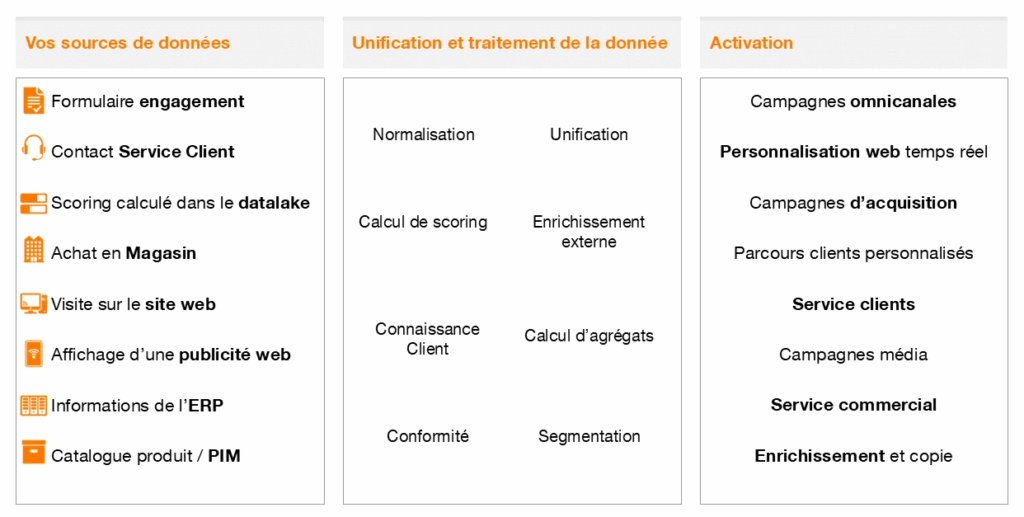
Illustration: example of a CDP-based architecture
This approach enables organizations to better address real-time use cases and personalization requirements across every customer interaction. As is widely recognized, data has become a central asset, and to maximize its value, it must be shared across all business functions.
This is particularly relevant for:
- Customer service teams, which need visibility into the most recent communications received by a customer.
- Sales teams, which may need to promote an offer aligned with the content of a recent SMS campaign.
- In-store sales associates, who require access to a customer’s full order history in order to provide more relevant advice.
A CDP makes it possible to support these use cases more effectively than Adobe Campaign v8 can natively.
Conclusion
As outlined above, making a decision is unavoidable. Choosing not to decide is, in itself, a decision, as any migration will inevitably take time.
The timeline constraint, with Adobe Campaign v7 support ending on March 31, 2027, requires organizations to start making decisions now, while all four options are still viable. There is just over a year remaining to prepare for a migration that will realistically take between 6 and 18 months, and more likely 12 to 18 months for options 3 and 4.
The right choice will depend on several factors: the level of technical complexity within the existing ecosystem, data and personalization ambitions (including CDP adoption), appetite for a managed cloud model such as v8 versus maintaining a controlled environment with v7, tolerance for risk, and overall migration budget. The coming months should therefore be dedicated to conducting a detailed inventory of the current setup, running a proof of concept, and building a three-year total cost of ownership (TCO) that accounts for both direct and hidden costs, including deliverability, skills, and reengineering efforts.
Organizations that take a structured and informed approach will be better positioned to turn this mandatory transition into a strategic opportunity.













Comments (0)
Your email address is only used by Business & Decision, the controller, to process your request and to send any Business & Decision communication related to your request only. Learn more about managing your data and your rights.