


Snowflake Intelligence has officially been available in General Availability since November 4, 2025 and is now accessible across all your Snowflake accounts! The ongoing AI revolution promises to analyze your data while interacting in natural language. It raises a key question: are dashboards still necessary? Let’s take a closer look in this article.
Snowflake Intelligence, the orchestration agent
To put it simply, the agent acts like a conductor with a range of instruments at its disposal. Depending on the request, it activates the most relevant ones to provide the right answer.
- Cortex Analyst: connects to relational data through a semantic layer that describes the content and relationships between your tables. It enables precise analysis of your datasets. However, this semantic layer is optimized for around ten tables, so it is often necessary to create multiple views when working with larger data models to avoid performance issues.
- Cortex Search: is used to explore unstructured data sources using RAG.
- Custom Tools: are user-defined tools built through stored procedures or functions. For example, they can allow the agent to trigger actions such as sending emails.

As you can imagine, to avoid false notes, the conductor needs the right score. In practice, this means giving the agent instructions that are as clear as possible. These instructions are defined when the agent is created through its system prompt. For example, you can specify that if the user does not mention a date, the agent should assume the analysis relates to the current year and make that clear in its response. Another option is to instruct the agent to ask the user to specify the period before launching the analysis.
These instructions can also guide the use of specific services depending on the type of request. For example, if the user is looking for information in product PDF sheets, the agent can be directed to use a dedicated tool such as “search_product.” As usual, Snowflake also makes it possible to govern access to these agents and to the underlying data through environment roles.
Example of conversational analysis to uncover hidden opportunities: Snowflake & Flux Vision
Flux Vision, developed by Orange Business, makes it possible to track population movements using mobile data.
It is a perfect “instrument” for our orchestration agent, allowing it to combine company sales data with population mobility insights.
By leveraging this combination of tools, sales teams can analyze performance with a broader perspective that goes beyond internal data and anticipate more relevant commercial actions.
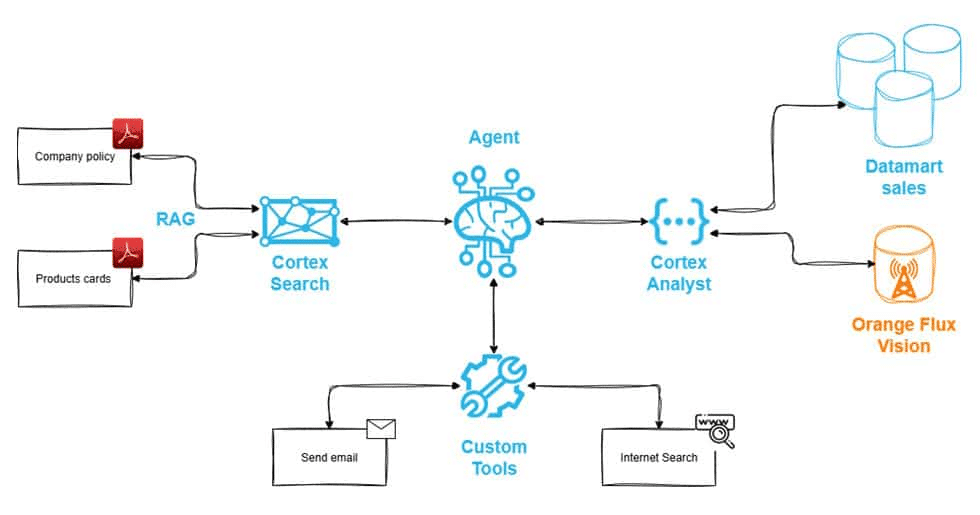
Diagram showing the different tools available to the agent in Snowflake Intelligence.
On the left side of the diagram are Cortex Search services, used to find information in documents such as product sheets or company legal documents, including commercial policies.
On the right side are Cortex Analyst services connected to semantic views. One is designed for the Sales Datamart and another for Flux Vision data. These semantic layers are essential to reduce hallucination risks in the results.
Finally, a few custom tools make it possible to send emails or search the web to confirm or challenge analyses that require data from outside the organization.
Let’s now look at the journey of two users:
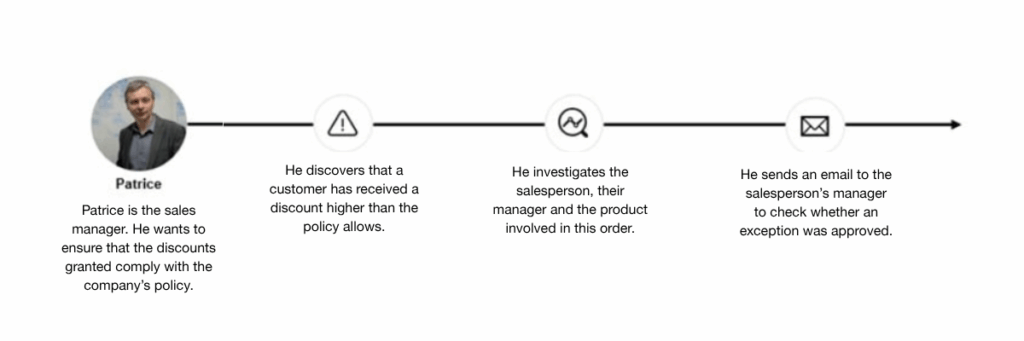
Initial question asked by Patrice: “Do the applied commercial discounts comply with the company’s policy?”
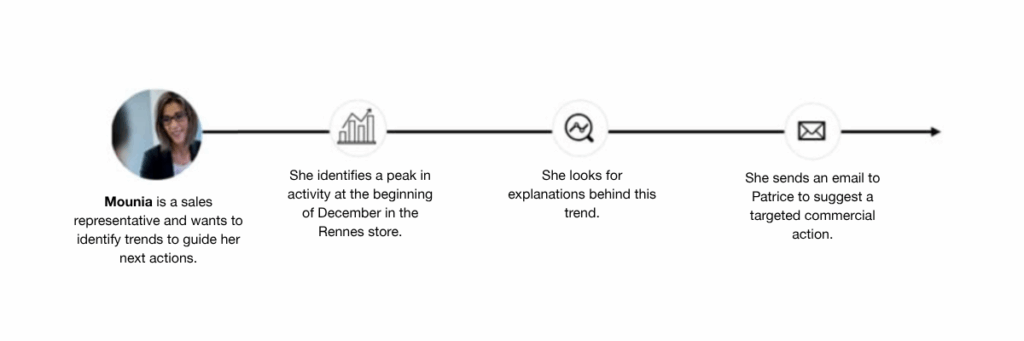
Initial question asked by Mouna: “Are there any monthly activity peaks in some of our stores?”
Each of these journeys relies on specific tools, and the agent’s system prompt can suggest visualizations to highlight the results. From there, it becomes a simple conversation between the user and the agent.
What makes this powerful is how easy it is to share insights. Users can generate a summary of the discussion and send it by email, or share it via Teams or Slack, without having to request a dashboard from the data team.
So, should we forget about dashboards?
✔️ Yes, the rise of AI is truly transformative and makes data more accessible to all types of users,
✔️ Yes, it makes it easier to combine structured and unstructured data,
✔️ Yes, there are more and more safeguards to reduce hallucinations and build trust in AI outputs, provided the data is of good quality,
✔️ Yes, analysis and sharing are faster, with results easily pushed to company communication channels,
✔️ Yes, it helps reduce Shadow IT and Shadow AI by providing users with versatile, ready-to-use tools,
❌ But no, dashboards are not dead. Natural language complements them rather than replaces them. For recurring monitoring, structured reporting or key indicators for decision-making, dashboards remain the reference and the most effective way to share insights.
Snowflake Intelligence acts as an accelerator for ad hoc analysis built on top of dashboards, enabling any user to better understand the data. Dashboard designers can rest assured, their expertise will remain essential!
Want to learn more? Looking to turn your flagship dashboard into a governed “conversational starting point”? Get in touch!













Comments (0)
Your email address is only used by Business & Decision, the controller, to process your request and to send any Business & Decision communication related to your request only. Learn more about managing your data and your rights.