


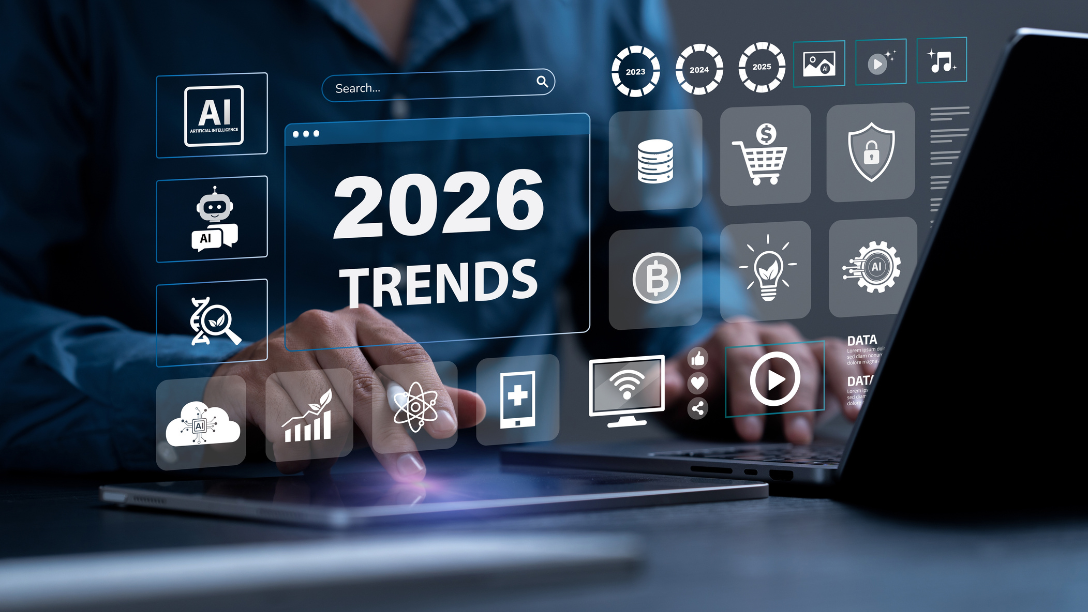
As we enter 2026, the Data & AI landscape is undergoing one of the most significant transformations since GDPR. Regulatory pressure is intensifying, cloud strategies are shifting toward sovereignty and interoperability, and AI is evolving into more autonomous, agent-driven systems. Organizations must now balance innovation, compliance, and operational speed in a highly dynamic environment.
The perspectives shared in this article are drawn from the field experience of Orange Business Data & AI experts who work daily with organizations across industries to design, govern and operate data platforms and AI systems. Based on real client projects and regulatory-driven transformations, they identify the trends that will define Data & AI strategies in 2026.
Contributing experts:
Yasser El Jasouli (Data Governance Expert), Benjamin Protais (Data Strategy Expert), Jérémy El Aissaoui (AI Expert), Mark Mauerhofer (Data & AI Expert), and Léo Lejeune (Data Solutions Expert).
1. AI governance becomes the top priority
AI governance rises to the forefront as 2026 marks the first major enforcement cycle of the EU AI Act. High-risk AI systems, general-purpose AI and foundation models will be subject to stringent transparency, documentation and oversight requirements.
To prepare, organizations are rolling out AI governance frameworks such as ISO/IEC 42001, along with model inventories, risk assessments, monitoring pipelines and cross-functional governance committees. While the AI Act does not mandate a specific “AI governance officer” role, many organizations are creating one, following the precedent set by GDPR and Data Protection Officers.
A key part of this shift is ensuring that data used by AI systems, especially large, complex collections of structured and unstructured data, is governed, high-quality and agent-ready. As autonomous AI capabilities expand, the reliability of underlying data becomes essential for safety and compliance.
With fines on par with or exceeding GDPR, AI governance becomes one of the largest compliance-driven transformation programs for the coming years.
2. The Data Act reshapes data sharing and cloud relationships
The EU Data Act brings the most significant change in data contracts in two decades. It mandates new rights for data access and portability, especially for connected products and services, and establishes expectations for fair cloud switching. To support implementation, the European Commission has published Model Contractual Terms (MCTs) and Standard Contractual Clauses (SCCs), which are non-binding templates that help organizations align with the regulation.
In practice, the act leads to contract renewals, redesigned data-sharing processes and greater transparency obligations. Manufacturing, automotive, energy, IoT and industrial sectors are especially affected, as they restructure governance and renegotiate long-standing agreements.
The Data Act also accelerates discussions around cloud exit, portability and vendor neutrality — topics that were previously conceptual, but now carry regulatory weight.
3. Sovereign cloud and multicloud architecture rise in importance
Data sovereignty was already a pressing topic across Europe, but combined with the Data Act’s emphasis on portability, organizations are now moving toward sovereign multicloud architectures. These designs priorities control over data location, interoperability, and the ability to switch providers without undue barriers.
Public sector, finance and healthcare lead the shift toward solutions hosted in local data centers or certified sovereign environments. In parallel, organizations preparing for autonomous AI increasingly require data environments that guarantee control, traceability and safe integration with sensitive workloads.
Cloud strategy is no longer simply a matter of IT efficiency; it has become a compliance, sovereignty and risk management obligation.
4. Unified data platforms gain momentum
To reduce fragmentation and improve governance, organizations are turning toward integrated, end-to-end data platforms. These unified ecosystems combine data engineering, warehousing, analytics, governance and machine learning in one environment. Examples include Microsoft Fabric, Snowflake’s unified platform strategy, Databricks’ Data Intelligence Platform and SAP Datasphere.
A major architectural evolution accompanying this shift is the rise of the multi-model architecture — platforms capable of supporting structured analytics, unstructured search, vector embeddings and graph reasoning within a single foundation. This transition reduces operational overhead and ensures that both traditional analytics and AI workloads operate on a consistent, governable data estate.
5. Legacy modernization accelerates
While many organisations initiated cloud transformations years ago, those operating in heavily regulated environments, such as manufacturing, energy or life sciences, are now accelerating data platform modernisation. This shift is largely driven by end-of-support timelines, maintenance modes and evolving vendor roadmaps for platforms such as SAP BW/BO and SAS.
For these companies, the primary objective is not immediate access to the most advanced capabilities, but ensuring long-term sustainability, maintainability and the ability to progressively adopt modern analytics and AI. In practice, this often involves modernizing long-standing on-premises analytics and reporting environments that have supported critical business processes for years.
Generative AI is also beginning to play a role in these modernization programs. Organizations increasingly experiment with GenAI-assisted data engineering to help refactor legacy pipelines, generate technical documentation or classify datasets, reducing the effort required to modernize complex environments.
While demand for advanced patterns such as lakehouse architectures, large-scale MLOps or massive parallel processing remains relatively limited in these sectors, the transition away from legacy platforms creates an opportunity to adopt modern cloud-based data stacks.
The main challenges lie in selecting the appropriate technology, such as Databricks, Snowflake or unified platforms like Microsoft Fabric, and in efficiently migrating long-standing data pipelines and data warehouses without disrupting business operations.
6. EPM modernization becomes a strategic imperative
Enterprise Performance Management (EPM) is being revisited as organizations face rapid market shifts and increasing operational complexity. Many finance teams still rely on spreadsheet-based planning cycles, which create bottlenecks and limit collaboration.
Modern EPM solutions enable integrated financial and operational planning, scenario modelling and real-time visibility. As companies aim to accelerate their planning processes, EPM modernization becomes a key enabler of agility.
7. Time-to-results becomes a competitive advantage
Speed of execution is emerging as a critical differentiator. Companies seek to move from identifying a need to delivering an insight in hours, sometimes minutes, rather than weeks.
This acceleration is powered by cloud-native compute, automation, real-time architectures and GenAI-enhanced data governance, which can automatically classify datasets, infer metadata, enrich lineage or even detect data quality issues at scale.
By reducing manual tasks, AI frees data teams to focus on higher-value work, tightening the gap between insight and outcome.
8. Enterprise AI agents transform operations
AI is evolving beyond conversational assistance toward agent-based systems capable of executing operational tasks across defined scopes. Organizations are beginning to deploy such agents in areas including IT operations, cybersecurity monitoring, procurement workflows and contract analysis, where automation can be tightly controlled.
This evolution requires organizations to rethink how decisions are made. A new balance is emerging between human-led decisions, agent-assisted workflows, and, in carefully bounded cases, agent-driven execution. As autonomy increases, clear governance boundaries, auditability and oversight become essential to ensure safety, accountability and regulatory compliance.
A critical enabler of this shift is the availability of agent-ready data. Both structured and unstructured data, including documents, knowledge bases and metadata, must be governed, high-quality and traceable so that agents can operate reliably and within defined constraints.
As agentic systems mature, they offer significant productivity gains, but they also introduce new operational and compliance risks. Anticipating and managing these risks early will be essential for organizations seeking to scale autonomous AI responsibly.

Agentic AI for Enterprises: Building Autonomy with Intent
Download ebook9. Synthetic data becomes a strategic enabler for AI under regulation
The AI Act emphasizes data quality, fairness, representativeness and risk mitigation. This pushes synthetic data into the mainstream as a practical way to train, validate and test AI models without exposing sensitive information.
Synthetic datasets help organizations address data scarcity, privacy constraints and bias-related challenges. Adoption is particularly strong in healthcare, mobility, finance and public services.
In practice, synthetic data becomes one of the most scalable and compliant-friendly ways to develop AI under Europe’s regulatory framework.
A turning point for Data & AI in Europe
2026 marks the beginning of a profound shift in how companies manage data, govern AI, architect cloud environments and make operational decisions. Sovereignty, regulation and automation are no longer separate themes; they are converging rapidly to reshape strategy across industries.
Organizations that succeed will be those able to combine innovation with compliance, speed with transparency, and autonomous AI with responsible governance. The foundations laid in 2026 will shape Europe’s digital and AI-driven economy for the decade ahead.









Comments (0)
Your email address is only used by Business & Decision, the controller, to process your request and to send any Business & Decision communication related to your request only. Learn more about managing your data and your rights.